hstry

A peasant in Euripides on wealth

c. 420–413 BCE, Athens (Theatre of Dionysus). The Peasant speaking, in Euripides’ play.

Where and when

c. 420–413 BCEAthens (Theatre of Dionysus)

about 2,442 years ago

Explore
Euripides, c. 480 – c. 406 BCE3000 BCE2900 BCE2800 BCE2700 BCE2600 BCE2500 BCE2400 BCE2300 BCE2200 BCE2100 BCE2000 BCE1900 BCE1800 BCE1700 BCE1600 BCE1500 BCE1400 BCE1300 BCE1200 BCE1100 BCE1000 BCE900 BCE800 BCE700 BCE600 BCE500 BCE400 BCE300 BCE200 BCE100 BCE1 CE100 CE200 CE300 CE400 CE500 CE600 CE700 CE800 CE900 CE1000 CE1100 CE1200 CE1300 CE1400 CE1500 CE1600 CE1700 CE1800 CE1900 CE2000 CEGreat Pyramid of Giza built, c. 2600 BCERome founded (traditional date), 753 BCELast western Roman emperor deposed, 476 CEGutenberg's printing press, c. 1440 CEColumbus reaches the Americas, 1492 CEFirst people on the Moon, 1969 CEToday, 2026sometime in these 7 years

Swipe the line. Bars: entries. Dots: events.

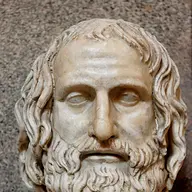
Euripides

, Athens (Theatre of Dionysus)The Peasant speaking, in Euripides’ play

In plain words, ours

Money matters for hosting guests and paying for the sick. But for everyday food it counts for little: a full stomach is the same for rich and poor.

It is in such cases, whenever I fail in my intentions, that I see how wealth has great power, to give to strangers, and to expend in curing the body when it falls sick; but money for our daily food comes to little; for every man when full, rich or poor, gets an equal amount.

Euripides, Electra lines 425–430Translated by E. P. Coleridge (1891)Read the full passage (Euripides, Electra lines 425–430, opens scaife.perseus.org)

What was going on, our summary

In Euripides' play, guests have come to Electra's humble home. She sends a peasant to fetch food from her father's old servant, because she can get nothing from her mother, who must not learn that Orestes is alive.

Checked claim by claim against: the passage around the quote.

Related moments

In time order, with this one in its place. Each says why it is here.

  1. c. 429 BCEabout 12 years earlier Iocasta on living at random Also about wealth, poverty and luck
  2. c. 430–425 BCEabout 10 years earlier Solon tells Croesus man is chance Also about wealth, poverty and luck
  3. c. 430–405 BCEDuring it Socrates would rather suffer wrong than do it Also in Athens
  4. c. 420–413 BCEThis momentA peasant in Euripides on wealth
  5. c. 420–413 BCEDuring it The peasant on noble birth and poverty More from Euripides
  6. c. 420–413 BCEDuring it Orestes on judging a man's worth Same passageMore from Euripides
  7. c. 420–413 BCEDuring it Orestes on judging a man's worth Same passageMore from Euripides
  8. 416 BCE1 year later Athens takes Melos and kills its men Same years
  9. set in 416 BCE1 year later Socrates on Love as the best helper Also in Athens
  10. 415 BCEabout 1.8999999999999773 years later Statues of Hermes are smashed across Athens Also in Athens
  11. 415 BCEabout 2 years later The great fleet sails for Sicily Same years
  12. c. 431–400 BCEDuring it Thucydides on how he wrote the speeches Same years

Just before and after

The text around the quote, word for word from the same translation.

Show the passageHide the passage

Electra: Since you, one of the small, have now made this error, go to my father’s dear old servant, who tends his flocks, an outcast from the city, by the river Tanaus which cuts a boundary between Argive land and the land of Sparta; bid him come, since these men have arrived at my house, and provide something for the guests’ meal. He will be glad, and will offer prayers to the gods, when he hears that the child, whom he once saved, is alive. I cannot get anything from my mother or from my father’s house; for we would bring bitter news, if she, the hard-hearted, were to learn that Orestes is still alive.

Peasant: I will take this message to the old man, if you wish; but go inside the house at once and make things ready there. Surely a woman, if she wants to, can find many additions to a meal. Really there is still enough in the house to cram them with food for one day at least.

The quote: Peasant: It is in such cases, whenever I fail in my intentions, that I see how wealth has great power, to give to strangers, and to expend in curing the body when it falls sick; but money for our daily food comes to little; for every man when full, rich or poor, gets an equal amount.

Peasant: Exeunt Electra and Peasant.

Chorus: O famous ships, you that once with countless oars went to Troy, conducting dances with the Nereids, where the music-loving dolphin leapt and rolled at your dark-blue prows, bringing Achilles, the son of Thetis, light in the leap of his foot, with Agamemnon to the banks of Trojan Simois. The Nereids, leaving Euboea’s headlands, brought from Hephaestus’ anvil his shield-work of golden armor, up to Pelion and the glens at the foot of holy Ossa, the Nymphs’ watch-tower . . .

Euripides, Electra lines 408–445Translated by E. P. Coleridge (1891)Read the full passage (opens scaife.perseus.org)

When, and whose words

Date
c. 420–413 BCE. The first staging of Euripides’ Electra is not recorded; estimates on style and allusions fall between about 420 and 413 BCE.
Whose words
The Peasant speaking, in Euripides’ play.
How this post was checked
  • The plain-words line was read against the quote alone by a second, independent pass, which found it adds no claim the quote does not make (2026-10-03).
  • Each claim in the summary was checked by an independent pass against only the material it cites.
  • The quote itself is checked by the build: word for word, once, at the cited section of the stored translation.

See it among its momentsMore from EuripidesSee it in the feed