hstry

Cicero on what we owe our country

44 BCE, written later. His own words.

Where and when

44 BCE, written laterRome and its world

2,069 years ago

Explore
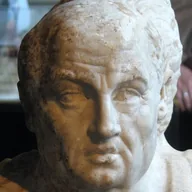
Cicero, 106 – 43 BCE3000 BCE2900 BCE2800 BCE2700 BCE2600 BCE2500 BCE2400 BCE2300 BCE2200 BCE2100 BCE2000 BCE1900 BCE1800 BCE1700 BCE1600 BCE1500 BCE1400 BCE1300 BCE1200 BCE1100 BCE1000 BCE900 BCE800 BCE700 BCE600 BCE500 BCE400 BCE300 BCE200 BCE100 BCE1 CE100 CE200 CE300 CE400 CE500 CE600 CE700 CE800 CE900 CE1000 CE1100 CE1200 CE1300 CE1400 CE1500 CE1600 CE1700 CE1800 CE1900 CE2000 CEGreat Pyramid of Giza built, c. 2600 BCERome founded (traditional date), 753 BCELast western Roman emperor deposed, 476 CEGutenberg's printing press, c. 1440 CEColumbus reaches the Americas, 1492 CEFirst people on the Moon, 1969 CEToday, 2026

Swipe the line. Bars: entries. Dots: events.

In plain words, ours

As Plato put it so well, we are not born just for ourselves. Our country has a claim on us, and so do our friends.

But since, as Plato has admirably expressed it, we are not born for ourselves alone, but our country claims a share of our being, and our friends a share;

Cicero, On Duties 1.22Translated by Walter Miller (1913)Read the full passage (Cicero, On Duties 1.22, opens scaife.perseus.org)

What was going on, our summary

Cicero writes this in 44 BCE, the year senators stabbed Caesar to death. Here he is explaining how land becomes private property and what people owe each other, leaning on Plato and the Stoics. The next year Cicero himself was killed on Antony's orders.

Checked claim by claim against: Caesar is stabbed to death in the Senate, Cicero is killed on Antony's orders, the passage around the quote.

Why it matters

About the event it belongs to: Caesar is stabbed to death in the Senate

The killing failed to restore the Republic. Instead it led to Caesar's deification and a civil war between his supporters and his killers, which became a stage in the Republic's collapse.

Based on Wikipedia: Assassination of Julius Caesar

The assassination failed to achieve its immediate objective of restoring the Republic's institutions.

Instead, it precipitated Caesar's posthumous deification and was followed by the Liberators' civil war (43–42 BC) between his supporters and the conspirators, which became a stage in the collapse of the Republic.

Wikipedia, Assassination of Julius Caesar (opens en.wikipedia.org), as of 2026-09-29. Text CC BY-SA 4.0. Our line is checked against these sentences only.

Related moments

In time order, with this one in its place. Each says why it is here.

  1. 46 BCE2 years earlier Cato kills himself rather than accept Caesar's pardon Same years
  2. 44 BCESame year Caesar is stabbed to death in the Senate The event behind it
  3. 44 BCE, written laterThis momentCicero on what we owe our country
  4. 44 BCE, written laterSame year Cicero on arms yielding to the toga More from Cicero
  5. 44 BCE, written laterSame year Cicero on the fox and the lion More from Cicero
  6. 44 BCE, written laterSame year Cicero on Cato's choice to die More from Cicero
  7. 43 BCE1 year later Cicero is killed on Antony's orders The event behind it
  8. 42 BCE2 years later Antony and Octavian defeat Caesar's killers at Philippi Same years
  9. c. 62–65 CEabout 106 years later Seneca on time, the only thing we own Also about how to live well
  10. c. 108 CEabout 151 years later Epictetus on facing death without lament Also about how to live well

Just before and after

The text around the quote, word for word from the same translation.

Show the passageHide the passage

There is, however, no such thing as private ownership established by nature, but property becomes private either through long occupancy (as in the case of those who long ago settled in unoccupied territory) or through conquest (as in the case of those who took it in war) or by due process of law, bargain, or purchase, or by allotment. On this principle the lands of Arpinum are said to belong to the Arpinates, the Tusculan lands to the Tusculans; and similar is the assignment of private property. Therefore, inasmuch as in each case some of those things which by nature had been common property became the property of individuals, each one should retain possession of that which has fallen to his lot; and if anyone appropriates to himself anything beyond that, he will be violating the laws of human society.

The quote: But since, as Plato has admirably expressed it, we are not born for ourselves alone, but our country claims a share of our being, and our friends a share;

and since, as the Stoics hold, everything that the earth produces is created for man's use; and as men, too, are born for the sake of men, that they may be able mutually to help one another; in this direction we ought to follow Nature as our guide, to contribute to the general good by an interchange of acts of kindness, by giving and receiving, and thus by our skill, our industry, and our talents to cement human society more closely together, man to man. The foundation of justice, moreover, is good faith— that is, truth and fidelity to promises and agreements.


Cicero, On Duties 1.21–23Translated by Walter Miller (1913)Read the full passage (opens scaife.perseus.org)

When, and whose words

Date
44 BCE, written later. On Duties was written in the autumn of 44 BCE, months after Caesar was killed.
Whose words
His own words.
How this post was checked
  • The plain-words line was read against the quote alone by a second, independent pass, which found it adds no claim the quote does not make (2026-10-03).
  • Each claim in the summary was checked by an independent pass against only the material it cites.
  • The quote itself is checked by the build: word for word, once, at the cited section of the stored translation.

See it among its momentsMore from CiceroSee it in the feed