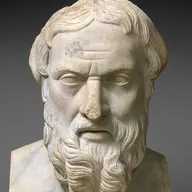
What was going on: Herodotus has finished describing the Nile and turns to Egypt, which he says has more wonders than anywhere else. He goes on to list more Egyptian customs that run opposite to everyone else's.
Egypt has its own weather and its own river, and mostly the opposite customs. Women trade at the market; men stay home and weave.
Just as the Egyptians have a climate peculiar to themselves, and their river is different in its nature from all other rivers, so, too, have they instituted customs and laws contrary for the most part to those of the rest of mankind. Among them, the women buy and sell, the men stay at home and weave; and whereas in weaving all others push the woof upwards, the Egyptians push it downwards.
His own words. Herodotus, Histories 2.35.2, translated by A. D. Godley (1920)
What was going on: Herodotus is in Egypt, at the field where Persian invaders beat the Egyptians after a fierce fight. Locals told him about the bones, and said the difference came from Egyptians shaving their heads and Persians wearing felt hats.
I saw something strange where the battle was fought: the Persian skulls are so brittle a pebble would go through them, while the Egyptian ones barely crack under a stone.
I saw a strange thing on the site of the battle, of which the people of the country had told me. The bones of those killed on either side in this fight lying scattered separately (for the Persian bones lay in one place and the Egyptian in another, where the armies had first separately stood), the skulls of the Persians are so brittle that if you throw no more than a pebble it will pierce them, but the Egyptian skulls are so strong that a blow of a stone will hardly crack them.
His own words. Herodotus, Histories 3.12.1, translated by A. D. Godley (1920)
Rome and its world100 BCE – 180 CE
Nothing here yet for the 330 years from 427 BCE to 100 BCE.
49–44 BCE: Caesar, civil war and the Ides of March
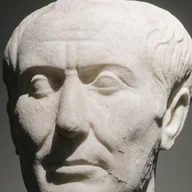
What was going on: 48 BCE: beaten by Caesar at Pharsalus in Greece, Pompey has fled to Egypt. Caesar writes that the men running the kingdom for the young king publicly invited Pompey to visit, but secretly sent Achillas and Septimius to kill him.
Why it matters: Caesar, pursuing Pompey, reached Alexandria, learned of the murder there, and was then embroiled in a dynastic dispute between Ptolemy XIII and Cleopatra.
He was greeted politely, drawn in because he knew a man who had once served under him, stepped into a small boat with a few friends, and was murdered.
And he, being courteously addressed by them and being lured forth by some previous knowledge of Septimius, because he had been a centurion under him in the pirate war, embarked in a little boat with a few of his friends, and is thereupon assassinated by Achillas and Septimius.
His own words. Caesar, The Civil War 3.104, translated by A. G. Peskett (1914)