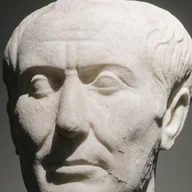
Caesar takes two expeditions to Britain. He wins battles and takes hostages but leaves no army behind. He writes that his eagle-bearer led the men off the ships.
Leap, fellow soldiers, unless you wish to betray your eagle to the enemy. I, for my part, will perform my duty to the commonwealth and my general.
What was going on: On Caesar's first landing in Britain, his warships have pushed the enemy on the shore back a little, but his men hesitate to jump into the deep sea. Caesar tells it himself, writing of himself in the third person.
Why it matters: Caesar achieved no significant gains in Britain, but simply landing there was a notable feat, and a propaganda victory he chronicled in his Commentaries.
The soldier carrying the legion’s eagle shouted for the others to jump unless they wanted to lose it to the enemy, then leapt from the ship himself.
…he who carried the eagle of the tenth legion, after supplicating the gods that the matter might turn out favorably to the legion, exclaimed, "Leap, fellow soldiers, unless you wish to betray your eagle to the enemy. I, for my part, will perform my duty to the commonwealth and my general." When he had said this with a loud voice, he leaped from the ship and proceeded to bear the eagle toward the enemy.
His own words, writing of himself as 'Caesar'. Caesar, The Gallic War 4.25, translated by W. A. McDevitte and W. S. Bohn (1869)
What was going on: On his second trip to Britain in 54 BCE, Caesar pauses his story to describe the island: its size, the people of Kent who live much like the Gauls, and inland people who live on milk and meat and dress in skins. Soon after, his cavalry clash with British horsemen and chariots.
Why it matters: Caesar's accounts are the earliest surviving significant eyewitness descriptions of Britain's people, culture and geography, effectively the start of the island's written history, or at least its protohistory.
The Britons all dye themselves blue with woad, which makes them look more frightening in battle. They wear their hair long.
All the Britains, indeed, dye themselves with woad, which occasions a bluish color, and thereby have a more terrible appearance in fight. They wear their hair long, and have every part of their body shaved except their head and upper lip.
His own words. Caesar, The Gallic War 5.14, translated by W. A. McDevitte and W. S. Bohn (1869)
27 BCE – 53 CE: Augustus and the first emperors
, Britain
Claudius invades Britain
Claudius sends an army under Aulus Plautius to Britain and crosses over himself for a few days. Suetonius says part of the island gave in without a fight.
he thence passed over to Britain, and part of the island submitting to him, within a few days after his arrival, without battle or bloodshed, he returned to Rome in less than six months from the time of his departure
After Romans flog her and abuse her daughters, Boudica, queen of the Iceni, leads a revolt that burns Camulodunum, London and Verulamium before Rome wins.
Boudicea, with her daughters before her in a chariot, went up to tribe after tribe, protesting that it was indeed usual for Britons to fight under the leadership of women.
What was going on: As Tacitus tells it: Boudica, queen of the Iceni, has led a revolt that burned three towns. Her huge army, so sure of winning that the Britons brought their wives in wagons to watch, now faces a Roman force of about ten thousand.
Why it matters:Rome's final victory over the revolt ended resistance to Roman rule in most of southern Britain, a period that lasted until AD 410.
With her daughters in her chariot, she went from tribe to tribe, saying Britons were used to going to war led by women.
Boudicea, with her daughters before her in a chariot, went up to tribe after tribe, protesting that it was indeed usual for Britons to fight under the leadership of women.
As Tacitus tells it. Tacitus, Annals 14.35, translated by A. J. Church and W. J. Brodribb (1876)B
What was going on: Britain, 60 or 61 CE. As Tacitus tells it, a vast British army, wives watching from wagons, faces the Roman legions, and Boudica rides with her daughters in a chariot from tribe to tribe to rouse them.
Why it matters: Boudica's battle speeches in Tacitus and Dio are thought never to have been recorded in her life, but these imagined speeches helped create an image of patriotism that turned her into a legendary figure.
I am not fighting as a noblewoman but as one of the people, for our lost freedom, my whipped body, and the violated honour of my daughters.
…it is not as a woman descended from noble ancestry, but as one of the people that I am avenging lost freedom, my scourged body, the outraged chastity of my daughters.
As Tacitus tells it. Tacitus, Annals 14.35, translated by A. J. Church and W. J. Brodribb (1876)B
What was going on: Britain, 60 or 61 CE, before a battle with the Romans. As Tacitus tells it, Boudica rides in a chariot with her daughters from tribe to tribe, speaking of her flogging and the abuse of her daughters. The huge British army has brought wives to watch from wagons.
Why it matters:Rome's final victory over the revolt ended resistance to Roman rule in most of southern Britain, a period that lasted until AD 410.
The gods are with a just revenge. One legion that dared fight us is dead. The rest are hiding in camp or thinking about running.
But heaven is on the side of a righteous vengeance; a legion which dared to fight has perished; the rest are hiding themselves in their camp, or are thinking anxiously of flight.
As Tacitus tells it. Tacitus, Annals 14.35, translated by A. J. Church and W. J. Brodribb (1876)B
What was going on: Britain, 60 or 61 CE. After Romans flogged Boudica and abused her daughters, she led a revolt that burned three towns. As Tacitus tells it, before the battle she drove with her daughters in a chariot from tribe to tribe.
Why it matters:Rome's final victory over the revolt ended resistance to Roman rule in most of southern Britain, a period that lasted until AD 410.
Think it through and you will see: in this battle we win or die. That is what a woman has decided. Men can live as slaves if they like.
If you weigh well the strength of the armies, and the causes of the war, you will see that in this battle you must conquer or die. This is a woman's resolve; as for men, they may live and be slaves.
As Tacitus tells it. Tacitus, Annals 14.35, translated by A. J. Church and W. J. Brodribb (1876)
97–180 CE: The high empire and the Stoic emperor
, Britain
Hadrian's Wall is begun across northern Britain
The emperor Hadrian has a stone wall built coast to coast across Britain, marking where Roman rule stops.