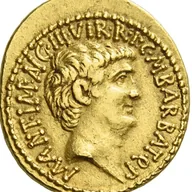
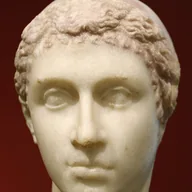
What was going on: Plutarch, writing over a century later, describes the years around 41–40 BCE, when Cleopatra carried Antony off to Alexandria. Meanwhile, he says, Antony's wife Fulvia was fighting a war at Rome to defend his interests, and a Parthian army was threatening Syria.
There he lived for fun like an idle young man, spending on pleasures what one writer called the costliest thing of all: time.
There, indulging in the sports and diversions of a young man of leisure, he squandered and spent upon pleasures that which Antiphon calls the most costly outlay, namely, time.
Plutarch, describing him, over a century later. Plutarch, Life of Antony 28.1, translated by Bernadotte Perrin (1920)
What was going on: Plutarch, writing over a century later, tells this from Antony's time with Cleopatra in Alexandria. Antony had secretly had divers fasten fish to his hook to impress her. She saw through it and invited her friends to watch him fish the next day.
She had a servant hook a salted fish on his line; everyone laughed, and she told him: leave fishing to the fishermen; your sport is hunting cities, kingdoms and continents.
…when Antony had let down his line, she ordered one of her own attendants to get the start of him by swimming to his hook and fastening on it a salted Pontic herring. Antony thought he had caught something, and pulled it up, whereupon there was great laughter, as was natural, and Cleopatra said: Imperator, hand over thy fishing-rod to the fishermen of Pharos and Canopus; thy sport is the hunting of cities, realms, and continents.
As Plutarch tells it, over a century later. Plutarch, Life of Antony 29.4, translated by Bernadotte Perrin (1920)
What was going on: After their defeat at Actium, Antony and Cleopatra are back in Alexandria, filling the city with feasts and revels. Plutarch, writing over a century later, describes their last months before both took their own lives.
Why it matters: The victory let Octavian consolidate his power over Rome and its lands. Historians generally see that consolidation and his new titles as the end of the Republic and the beginning of the Empire.
They closed their party club and started a new one, just as lavish, called Partners in Death. Their friends joined as people who would die together.
Cleopatra and Antony now dissolved their famous society of Inimitable Livers, and founded another, not at all inferior to that in daintiness and luxury and extravagant outlay, which they called the society of Partners in Death. For their friends enrolled themselves as those who would die together, and passed the time delightfully in a round of suppers.
Plutarch, describing him, over a century later. Plutarch, Life of Antony 71.3, translated by Bernadotte Perrin (1920)
, Alexandria
Antony and Cleopatra take their own lives
With Octavian at Alexandria, Antony falls on his sword and Cleopatra dies days later. Plutarch tells the asp story and says no one knows how she died.
What was going on:Alexandria, 30 BCE, after Octavian's fleet beat Antony and Cleopatra at Actium. As Plutarch tells it, Antony's ships and cavalry had just gone over to the enemy, and Cleopatra, afraid of his anger, shut herself in her tomb and sent word that she was dead.
Why it matters: The victory let Octavian consolidate his power over Rome and its lands. Historians generally see that consolidation and his new titles as the end of the Republic and the beginning of the Empire.
Believing the message, he said: I am not sad to lose you, Cleopatra, since I will join you soon. I am sad that a woman was braver than me.
Antony believed the message, and saying to himself, Why dost thou longer delay, Antony? Fortune has taken away thy sole remaining excuse for clinging to life, he went into his chamber. Here, as he unfastened his breastplate and laid it aside, he said; O Cleopatra, I am not grieved to be bereft of thee, for I shall straight-way join thee; but I am grieved that such an imperator as I am has been found to be inferior to a woman in courage.
As Plutarch tells it, over a century later. Plutarch, Life of Antony 76.3, translated by Bernadotte Perrin (1920)
What was going on:Alexandria, 30 BCE: a year after losing to Octavian at Actium, Antony has fallen on his sword. As Plutarch tells it, Cleopatra and her women hauled him up to her on a rope, and, dying, he asked for wine before speaking to her.
Why it matters: With Antony's death, Octavian became the uncontested ruler of Rome.
He told her to look after her own safety and not mourn him: he had been great and powerful, and was beaten honourably, a Roman by a Roman.
When he had drunk, he advised her to consult her own safety, if she could do it without disgrace, and among all the companions of Caesar to put most confidence in Proculeius, and not to lament him for his last reverses, but to count him happy for the good things that had been his, since he had become most illustrious of men, had won greatest power, and now had been not ignobly conquered, a Roman by a Roman.
As Plutarch tells it, over a century later. Plutarch, Life of Antony 77.4, translated by Bernadotte Perrin (1920)
What was going on: As Plutarch tells it, over a century later: Antony is dead and Cleopatra is closely guarded in Alexandria, 30 BCE. Told that Octavian means to send her and her children away within three days, she asks to pour offerings at Antony's tomb, and speaks to the urn with his ashes.
Why it matters: With Antony dead, Octavian became the undisputed master of the Roman world. After Cleopatra's death Egypt became a Roman province, marking the end of the Hellenistic period.
These are my last offerings to you. Nothing parted us in life, but in death we may swap places: you buried here, and me in Italy.
Do not expect other honours or libations; these are the last from Cleopatra the captive. For though in life nothing could part us from each other, in death we are likely to change places; thou, the Roman, lying buried here, while I, the hapless woman, lie in Italy, and get only so much of thy country as my portion.
As Plutarch tells it, over a century later. Plutarch, Life of Antony 84.3, translated by Bernadotte Perrin (1920)
What was going on:Alexandria, 30 BCE, with Octavian at the city. Messengers open Cleopatra's room and find her dead on a golden couch, Iras, one of her women, dying at her feet. Plutarch, writing over a century later, gives the story people told and admits no one knows how she died.
Why it matters: With Antony dead, Octavian became the undisputed master of the Roman world. After Cleopatra's death Egypt became a Roman province, marking the end of the Hellenistic period.
It is said a snake was hidden under figs and leaves. When she saw it, she said: there it is, and held out her arm for the bite.
It is said that the asp was brought with those figs and leaves and lay hidden beneath them, for thus Cleopatra had given orders, that the reptile might fasten itself upon her body without her being aware of it. But when she took away some of the figs and saw it, she said: There it is, you see, and baring her arm she held it out for the bite.
As Plutarch tells it, over a century later. Plutarch, Life of Antony 86.1, translated by Bernadotte Perrin (1920)