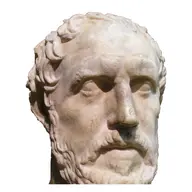
What was going on: As Thucydides writes it, Athenian envoys are talking with the people of Melos, a neutral island that refuses to join Athens, in 416 BCE. The Athenians say they will skip fine speeches about their right to an empire. After a siege, Athens killed Melos' men and enslaved the women and children.
Why it matters: The Melian dialogue is regarded as a seminal text of international relations theory, and this line in particular is taken as an appeal to political power as opposed to justice.
In the real world, fairness only comes up between equals in power. Otherwise the strong do what they can and the weak put up with what they must.
…since you know as well as we do that right, as the world goes, is only in question between equals in power, while the strong do what they can and the weak suffer what they must.
The Athenian envoys speaking, as Thucydides writes it. Thucydides, History of the Peloponnesian War 5.89.1, translated by Richard Crawley (1874)
What was going on: In 416 BCE an Athenian force came to Melos, a neutral island that refused to join Athens. In the talks Thucydides writes up, the Melians say the gods will favor them as just men and the Spartans will help; here the Athenian envoys reply.
Why it matters: The Melian dialogue describes one of the early instances of power politics, and it is taught as arguing that the only rational approach is based on power and advantage.
Gods, we think, and people, we know, rule wherever they can. We didn't invent that rule, we just use it, and you would too in our place.
Of the gods we believe, and of men we know, that by a necessary law of their nature they rule wherever they can. And it is not as if we were the first to make this law, or to act upon it when made: we found it existing before us, and shall leave it to exist for ever after us; all we do is to make use of it, knowing that you and everybody else, having the same power as we have, would do the same as we do.
The Athenian envoys speaking, as Thucydides writes it. Thucydides, History of the Peloponnesian War 5.105.2, translated by Richard Crawley (1874)