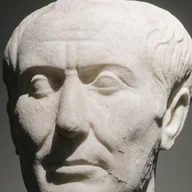
As governor, Caesar fights the peoples of Gaul for eight years and brings the whole country under Rome. He tells the story himself, in the third person.
All Gaul is divided into three parts, one of which the Belgae inhabit, the Aquitani another, those who in their own language are called Celts, in our Gauls, the third.
What was going on: These are the opening lines of Caesar's own account of his war in Gaul, which he fought as governor from 58 BCE and wrote up himself, in the third person. He begins by mapping the land and its peoples, river by river.
Why it matters: The opening phrase is frequently quoted, and the book has long been a mainstay in Latin instruction due to its simple, direct prose.
Gaul is split into three parts, each held by a different people. They all differ in language, customs and laws.
All Gaul is divided into three parts, one of which the Belgae inhabit, the Aquitani another, those who in their own language are called Celts, in our Gauls, the third. All these differ from each other in language, customs and laws.
His own words. Caesar, The Gallic War 1.1, translated by W. A. McDevitte and W. S. Bohn (1869)
What was going on: In 55 BCE, with only a short part of summer left, Caesar has just come back to Gaul after eighteen days across the Rhine. Writing of himself, he says he decided to cross to Britain because it had sent help to his enemies in almost every war with the Gauls.
Why it matters: No information about harbours or landing-places was available to the Romans before these expeditions, and it is likely the intelligence gathered was later used by Claudius in planning his landings.
Even if there was too little of the season left for a war, just landing on the island would teach me about its people, harbours and landing places.
…even if the time of year should be insufficient for carrying on the war, yet he thought it would be of great service to him if he only entered the island, and saw into the character of the people, and got knowledge of their localities, harbors, and landing-places, all which were for the most part unknown to the Gauls.
His own words, writing of himself as 'Caesar'. Caesar, The Gallic War 4.20, translated by W. A. McDevitte and W. S. Bohn (1869)