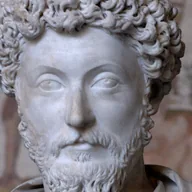
What was going on: Marcus Aurelius, keeping a private notebook while at war on the Danube frontier around 170–180 CE, lists what he learned from each of his teachers. Here it is Rusticus, who taught him to write plain letters and to forgive easily.
Why it matters: Rusticus, the teacher Marcus thanks here, would have the strongest influence on him; Fronto saw him as the man who drew Marcus away from oratory.
“He” here is Rusticus.
He taught me to read carefully, not skim, and not to agree too fast with people who talk a lot. And he gave me the discourses of Epictetus from his own collection.
…and to read carefully, and not to be satisfied with a superficial understanding of a book; nor hastily to give my assent to those who talk overmuch; and I am indebted to him for being acquainted with the discourses of Epictetus, which he communicated to me out of his own collection.
His own words, in the Meditations, notes written for himself. Marcus Aurelius, Meditations 1.7, translated by George Long (1862)
What was going on: From the Meditations, the private notebook in Greek that Marcus kept while fighting tribes on the Danube. Here he lists what he learned from people in his life: his grandfather, his father, then his mother.
Why it matters: The Meditations became one of the most important sources for the modern understanding of ancient Stoic philosophy, and many commentators count it among the greatest works of philosophy.
From my mother: devotion and kindness, keeping away from bad deeds and even bad thoughts, and living simply, far from the ways of the rich.
From my mother, piety and beneficence, and abstinence, not only from evil deeds, but even from evil thoughts; and further, simplicity in my way of living, far removed from the habits of the rich.
His own words, in the Meditations, notes written for himself. Marcus Aurelius, Meditations 1.3, translated by George Long (1862)
, the Danube frontier
Marcus Aurelius dies on campaign
Marcus dies near the Danube front while still at war. His son Commodus becomes sole emperor.