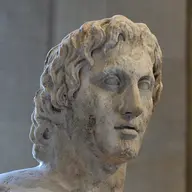
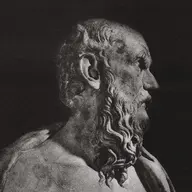
What was going on: As Plutarch tells it, centuries later, the Greeks had just met at the Isthmus and named Alexander leader of a war against Persia. Statesmen and philosophers came to congratulate him, but Diogenes, staying in Corinth, ignored him, so Alexander went to see him in person.
Why it matters: Alexander's encounter with Diogenes, during his stay in Corinth, became famous.
Alexander came to see Diogenes, who was lying in the sun, greeted him, and asked if he wanted anything.
Alexander went in person to see him; and he found him lying in the sun. Diogenes raised himself up a little when he saw so many persons coming towards him, and fixed his eyes upon Alexander. And when that monarch addressed him with greetings, and asked if he wanted anything,
As Plutarch tells it, centuries later. Plutarch, Life of Alexander 14.2, translated by Bernadotte Perrin (1919)
What was going on: As Plutarch tells it, centuries later, the Greeks had just voted Alexander leader of an expedition against Persia. Many came to congratulate him, but Diogenes kept lying in the sun near Corinth, so Alexander went to him and asked if he wanted anything.
Why it matters: Memorable encounters like this one with Alexander made Diogenes a lasting symbol of philosophical defiance of established authority.
Yes: move over a little, you're blocking my sun.
Yes, said Diogenes, stand a little out of my sun.
As Plutarch tells it, centuries later. Plutarch, Life of Alexander 14.2, translated by Bernadotte Perrin (1919)
What was going on: As Plutarch tells it, centuries later, Alexander went to see Diogenes in Corinth when the philosopher did not come to congratulate him. He found him lying in the sun, asked if he wanted anything, and was told to stand out of his sun.
His men were laughing at the philosopher. Alexander said: if I weren't Alexander, I would be Diogenes.
…he said to his followers, who were laughing and jesting about the philosopher as they went away, But verily, if I were not Alexander, I would be Diogenes.
As Plutarch tells it, centuries later. Plutarch, Life of Alexander 14.3, translated by Bernadotte Perrin (1919)
, Corinth
Diogenes the Cynic dies in Corinth
Diogenes dies at Corinth, nearly ninety by one account. One ancient writer says it was the same day Alexander died; modern scholars think that is likely legend.
Demetrius in his work On Men of the Same Name asserts that on the same day on which Alexander died in Babylon Diogenes died in Corinth.